OUR REZ (Reservation)
Ever wonder what the reservations are really like? Not like the ones that you would read about that have been put through a set of suffering circumstances - whose houses lapsed into severe states of disrepair. I mean the normal run-of-the-mill reservation or "REZ".
I have had the opportunity to travel extensively throughout North America and I have taken the time to drive through some of the reservations and pueblos. Most of rez's feel like any rural town. They have gas bars, variety stores, and in some cases shopping malls. Some have cities, like Tuba City on the Navajo reservation in the southwest states. Tuba City has all of the amenities of urban life - high schools, rodeo pit, banks, theatres, and even fast food joints like McDonalds and Burger King.
Some reservations like those of the Hopi and Pueblo people, cling to their old ways, shunning electricity and water systems for life in the adobe houses. The Taos pueblo is at least a thousand years old and the people that live there today are descendants to the people who lived there long before the Europeans came to visit and stay.
Our Rez (Nipissing First Nation) is on the shores of Lake Nipissing on the edge of North Bay Ontario. We occupy a thin strip of land that extends some 40 km along the lake. The section where I live is very narrow - seemingly, because the two railways and one transcontinental highway follow the shoreline as well which forces us to squeeze in along the tracks. Consequently, the majority of us are living on land that is as narrow as 50 metres to as wide as 200 metres.
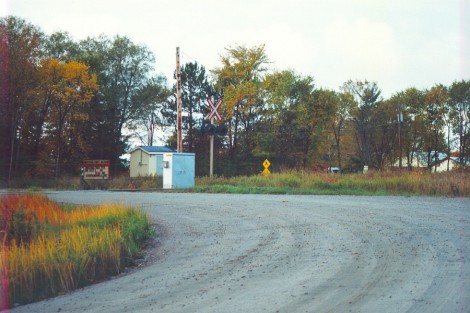
The Entrance to the "REZ"
The initial treaty that signed over the lands to the railroad is hotly debated even today. As the story goes, a very drunk chief had to be physically held up by the government Indian Agent so he can sign an 'X' on the document. The various accounts of this event still circulates the fireside talks. Whatever the case, it's still home.
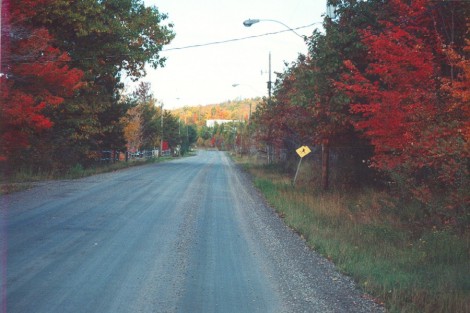
The "Main Drag"
Some History
My father, who today is 90 years old, has told me the stories of the Rez when he was growing up (this will be given another section on this web site at a later date). I feel some of the stories must be written now as the history of lands was not well documented in the past current controversy has arisen about the land's history.
For example, our neighbours right next door may have built their garage on top of a grave site. They did not know this at the time, and since there are very few people alive today who remember this, it may be worthwhile to investigate and record this fact.
My father grew up on this section of the rez where he hunted, fished and farmed the area since the early 1920's. A large section this end of the rez was farmed by two families - the Commandas and the Couchies. My great grandfather had a very large farm that had a large pasture; garden plots with beans and veggies; as well as a large timber barn that housed cattle and turkeys.
To see the place now, one can not imagine a large agricultural occupation taking place as this acreage now has houses, streets and very large trees. Even in my memory when I used to explore the bush around here, there were no signs of habitation. This area was mostly trees and shrubs from the the old timber church beside my great-grandfather's old deserted house westward 3/4 Km to where we live today.
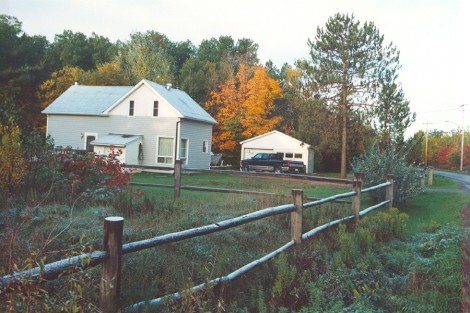
My Grandfather (Dawdaw) and Grandmother's (Dodo) house. This was the end of the road back when I was a little fella.
When I say this section, I mean the section that is west of my grandfather's house which was at the end of the road.(see the picture above)There was only one house west of my grandfathers and that was Old Joe's. To get to Old Joes, one would either have to walk along the railroad tracks or take another road which was off of the main highway. Besides Old Joe's house, this section contained the old church and, of course, the Roman Catholic (RC) graveyard.
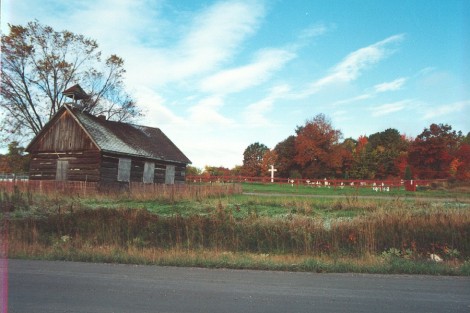
The Old Church and Graveyard
Funny thing about the graveyard; you had to be a good RC to get buried in there. Back in the 1920's my father's best friend John, was of African decent who was adopted by one of the Commanda families. One night he went to Sturgeon Falls (at the other end of the Rez, 25 miles away) and had gotten drunk. He hopped a freight train to come back to this end of the rez and ended up under the wheels of the train.
As the story goes, the priest did not want John buried in the church graveyard - for whatever reason. So he was buried just outside the fence that surrounds the graveyard. As time went on and more people died, the graveyard needed to be expanded. My grandfather was the guy who maintained the graveyard, so he simply moved the fence. You guessed it. My father's friend, John, was now buried inside the RC graveyard. Apparently, the priest was furious, but could not do anything about it.
Another story..... Most of the section where people live today was farmland or garden plots. Where our house sits today was a potato patch that was maintained by a gentleman who jogged to the patch every day from his house some 2 Km away. For some reason he would tie string around his calves, just below the knees, when he ran to and from the patch. Along his path there was a fence that ran from the lake shore to the railway tracks about 200 m west of the church. A set of stairs was built over the fence that allowed a person to climb over the fence. One day the old guy was found laying over these stairs - an apparent heart attack took him.
TODAY our section of the rez has a gas bar and variety store. We have gravel roads, which for the most part, are well maintained. We have running water supplied by a number of wells maintained by the rez council. Yes, we have electricity and with that, cable and satellite TV, and the Internet.
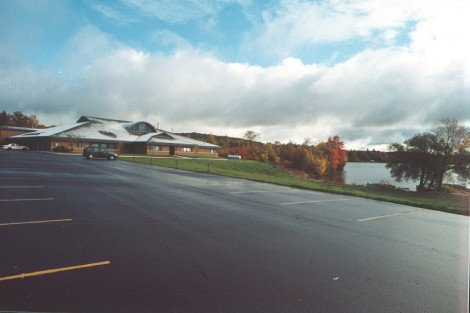
The Rez High School. It sits on the location of my Great Grandfather and Mother's house (John and Marianne)
We don't seem to have crime as it's known in the city. People here seem to be law biding and for the most part, honest. I can leave tools outside and still find them the next day.
There is room for growth and improvement here, but in spite of the apparent lackings, living on the rez is very quiet and restful.